Write It Down: Why Words Still Matter
OPINION
By Richard Evans, President Whitsundays Writers Festival
Before most of us have finished breakfast, we have probably written something.
A shopping list. A text message. A reminder to buy milk. Perhaps a note to ourselves that makes perfect sense at 7am and looks remarkably mysterious by lunchtime.
None of this feels particularly literary. Yet these small acts belong to the same human impulse that produces a poem, a diary, a short story or a novel.
We write to communicate, certainly. But we also write to think.
There is something interesting about putting words on a page. A thought that seemed perfectly clear in our head can become surprisingly slippery once we try to write it down. Suddenly we have to decide what we actually mean.
The novelist E.M. Forster put it neatly: “How can I tell what I think till I see what I say?”
Writing slows us down just enough to make us choose.
A vague feeling becomes a sentence. A complicated idea becomes something we can explain. An argument that sounded convincing in our head can occasionally be exposed as complete nonsense.
That last discovery can be particularly useful.
Writing is therefore not just something we do when we have something important to say. It is one of the ways we work out what we have to say in the first place.
Nor does it need to be long. Consider the six-word story often credited to Ernest Hemingway: “For sale: baby shoes, never worn.”
Six words, and an entire story of hope and loss. There is no evidence Hemingway wrote it, but it endures because it shows what every writer learns: what we leave out can matter as much as what we put in.
Think about how many forms writing takes in an ordinary life.
There is the email that prevents a misunderstanding. The handwritten note that simply says, “I was thinking of you.” The letter that takes a little longer to arrive but somehow carries more weight. There is the diary where private thoughts have somewhere to land, the poem that manages to say in ten lines what prose might take pages to explain, and the story that allows us to briefly inhabit somebody else’s life.
Then there is the manuscript.
The manuscript is a different beast altogether. It requires persistence, patience and the willingness to discover that the brilliant sentence you wrote yesterday may not be quite so brilliant today.
Writing is also exercise for the mind. It asks us to remember, concentrate, find words, organise ideas, make choices and use our imagination.
The keyboard has made writing faster, but speed is not necessarily the same as depth. There is something about writing by hand, the physical movement and the deliberate pace, that can give the mind a little more time to select, connect and remember.
But whether it is ink on paper or fingers on a keyboard, the important thing is that we keep doing it.
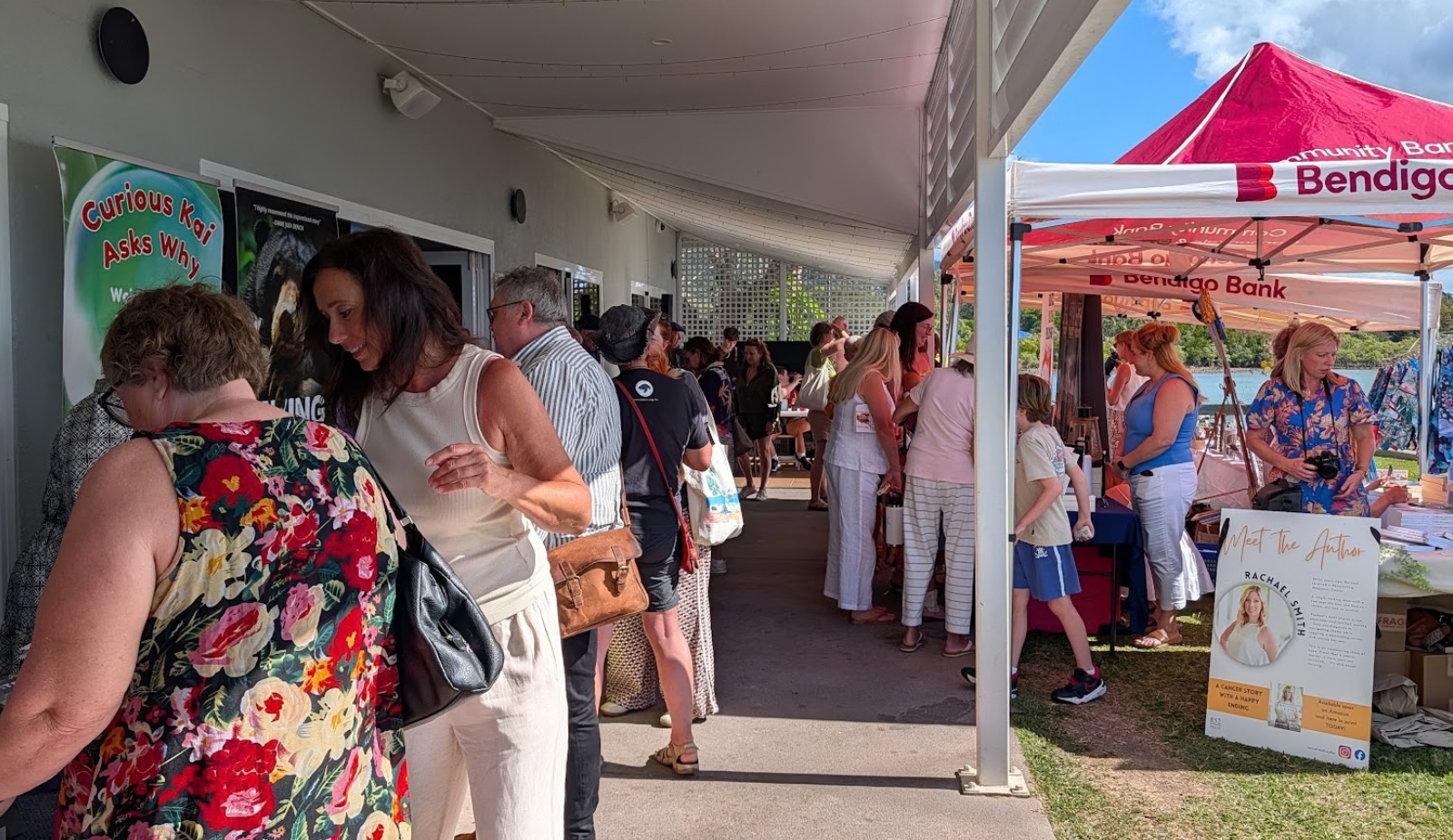
At the Whitsundays Writers Festival, we see people with very different ambitions. Some want to write a memoir. Some want to write poetry. Some dream of a crime novel. Others simply want the encouragement to put the first words on the page.
What they discover is that writing is not reserved for the naturally gifted.
It is a practice. And like most things we practise, we get better at it.
So here is my suggestion for today. Write something.
Not a novel. Not even a short story.
Write a paragraph about the view from your window. Describe a person you remember. Record something funny that happened this week. Try a six-word story of your own. Write a letter to someone you care about, even if you never send it.
It doesn’t have to be good.
It just has to be written.
Because every time we put words on a page, we do more than communicate with someone else. We give our thoughts somewhere to live.
And sometimes, that is where the interesting things begin.